
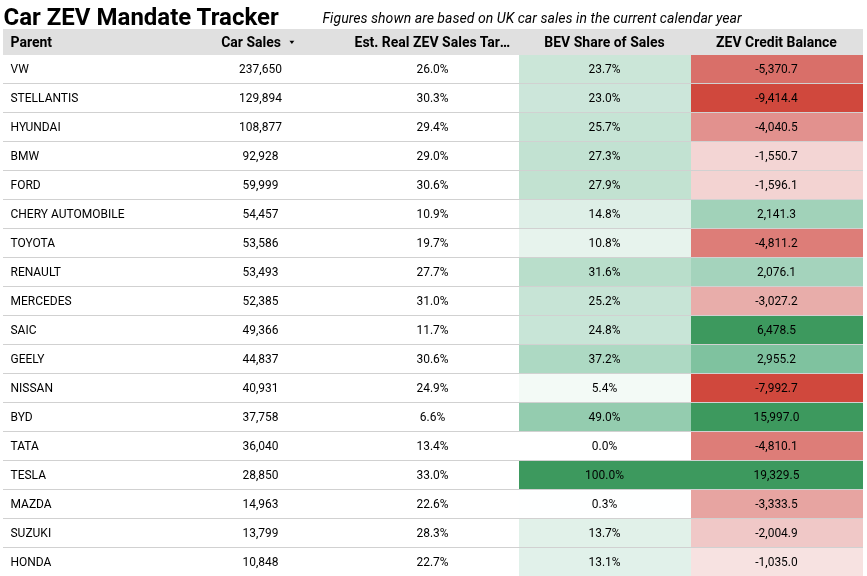
At half way through 2026, our regular ZEV mandate tracker table tells a simple story: the green numbers are bigger than the red ones. There are more compliance credits for sale than there are buyers. If you are a carmaker behind on your targets, this is excellent news. Compliance is cheap, and it will get cheaper as the year goes on.
At the halfway mark, the market has split into three camps: the doing-greats, the just-about-managing, and the stragglers. Nobody ever wants to pay attention to the middle, so neither will we.
Start with the stragglers. Stellantis, Toyota, Nissan and Tata (Jaguar Land Rover) are all well behind. The reasons vary. JLR stopped selling electric cars. Nissan is making its cars neither more efficient nor more electric. Toyota briefly sold a lot of EVs in the UK, then apparently thought better of it. Stellantis sells both EVs and hybrids, just not enough of either.
None of this is necessarily irrational. When credits are in surplus, it can be cheaper to buy somebody else’s than to build and sell EVs yourself, particularly if, like JLR, your EV is coming, just not in time to hit this year’s target.
If someone is buying, someone is selling. The biggest surpluses belong to Tesla, naturally, but also the Chery, Renault, SAIC, Geely, and BYD. That Chinese tilt prompted the Chancellor, Rachel Reeves, to complain this month that the mandate pays out to “foreign companies, such as those in China, that produce more electric vehicles.”
Well, quite! But hold that thought.
The standard argument runs: China makes cheaper EVs than anyone else, so promoting EVs promotes Chinese carmakers at the expense of domestic incumbents. It sounds airtight. We’re not so sure.

We analysed UK import data to compare Chinese cars with European (ex-UK), American, and other imports. The bad news for Western carmakers: China does not just make cheaper EVs. It makes cheaper everything. And as BYD’s surging PHEV sales demonstrate, these companies will happily sell the UK whatever the UK wants to buy.
The implication is uncomfortable. Weakening the ZEV mandate does not shield incumbents from Chinese competition. It just changes the vehicles that competition arrives in. A reprieve, but only a temporary one.
So what should the government do? Rebalance, not retreat. Shift the EV obligation away from incumbents and place it equally on new entrants, via the rules on hybrids, credit transfers and other flexibilities, while leaving the headline targets intact. The message to new arrivals would be clear: come to the UK by all means, but bring only your cleanest, best value cars.